The field of market systems development (MSD) was built on the implicit assumption that large projects would continue to be publicly procured by bilateral donors, indefinitely. That assumption has been shattered, and organizations need to rethink their staffing, business development and governance models to adapt to the changing funder landscape.
Let me take you back to 2020, an eventful year! Personally, I spent 9 months in New Zealand, experiencing the uniquely Kiwi approach to navigating the pandemic. While I was there, I was also co-facilitating four parallel 'clinics' focused on the nerdiest topic ever: Procurement and contracting of MSD programmes. One of these stories comes up a lot at dinner parties, the other - not so much.
Fast forward to 2025: the demise of USAID, the slashing of aid budgets to boost military spending, a major reshuffling of the development sector. This brought utter chaos for many MSD practitioners and consultants whose projects closed overnight, and whose organizations had budgets evaporate.
I want to link these two disruptive years together, by dusting off one of the MSD procurement papers from 2020 to explain its relevance to shifting funding dynamics for MSD today. 'Decisive structures' analyses a range of procurement formats used by donors to set-up MSD programmes to show their strengths and weaknesses. See below for the spectrum of formats and a rough heuristic of the funder types engaged with each format.
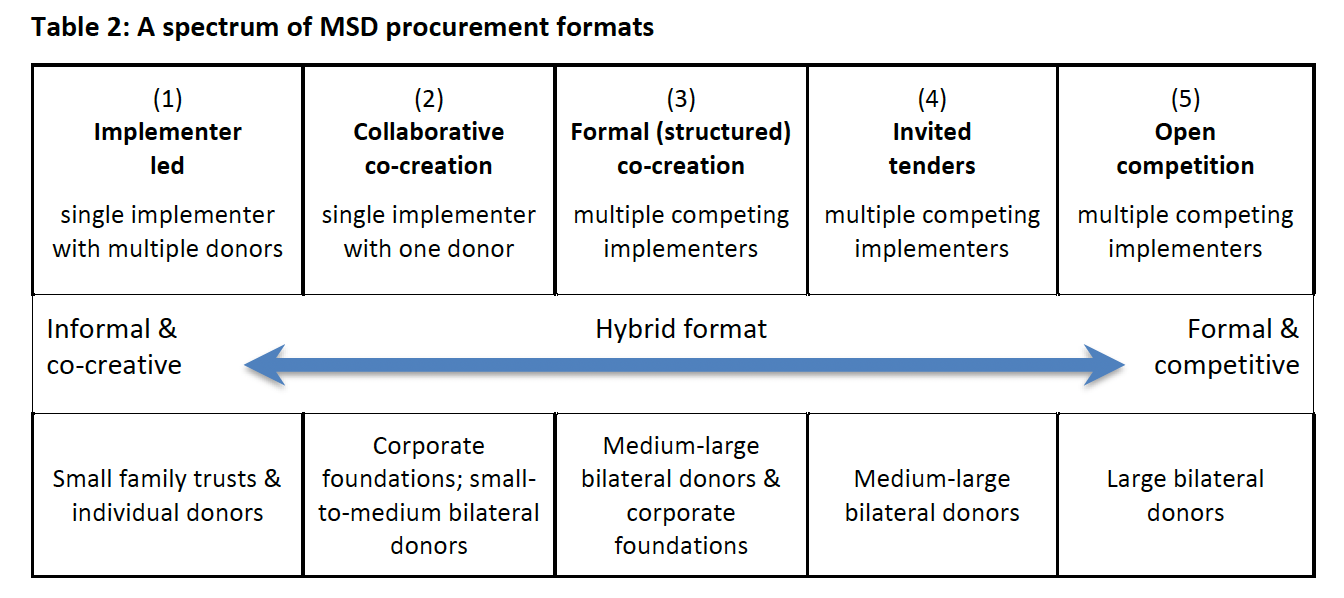
Moving from left to right, the procurement formats shift from more informal and co-creative to more formal and competitive. In retrospect, the idea of 'implementer-led' procurement was quite bizarre and almost foreign at the time of writing in 2020. Collaborative co-creation? This sounded like dreamy, idealistic stuff. The implicit assumption was that the 'big game' in MSD was all happening on the right-hand side of the spectrum. Writing the paper series, after all, was meant to shine a light on problematic norms and assumptions of the dominant mode, open competition.
The majority of the large, recognized MSD projects were spawned through that modality, however painful. The major bilateral donors, including those who funded the BEAM Exchange, operated primarily through public procurement of large programmes. This business model became a trusted lifeline for implementers and consultants alike. Many of those same organizations have felt the pain of sudden shifts in aid budgets as that core business has deflated like an untied balloon.
The Rise of New Funders
What is interesting about the present moment, in early 2026, is the rising importance in MSD circles of new types of funders, who themselves lean more "to the left". Foundations - private family and corporate – are on everyone's mind. Yet these foundations operate on fundamentally different timescales than bilateral donors who are locked into parliamentary budget cycles. In contrast, foundations might commit to 7-10-year initiatives... or pivot overnight when leadership or strategy changes. Without taxpayer accountability, they can approve multi-million-dollar investments in weeks rather than years, and fund risky or politically sensitive work that bilateral donors cannot.
Diversification has gone from a strategic priority to a means of survival. And yet foundations are not monolithic in their approach, with enormous variation in culture, structure and preferred formats for procuring projects. Many foundations use invite-only calls and direct relationships, and they are much more comfortable with co-creation - which can even blur the traditional roles of funder and implementer.
Timelines can be accelerated (or delayed) - meaning less predictability than the bilateral world, with more rigid budget cycles. This is amplified in scenarios where foundation CEOs are actively involved in shaping and deciding whether to fund specific projects - the stakes are higher with fewer layers of bureaucracy.
Direct acquisition - or "implementer-led" procurement as we clumsily labelled it back at the time, is also being actively explored by key MSD implementers. Country and regional teams are drawing up project ideas, getting them started on lean staffing models, and using that learning to "pitch" their project to a range of donors for more substantial funding. This is no longer a fairytale, but a legitimate part of new and evolving business models.
What does this "shift to the left" mean for MSD?
1. Uncertainty in the pipeline
Uncertainty in the pipeline of large multi-year MSD programmes and a likely shrinking of average MSD project budgets. This means big financial challenges for implementers used to living off healthy overheads/margins from well-funded project budgets. The fall of USAID has already instantly dropped average budget per project-year significantly, but planned changes from others seem likely to continue this trend into the future.
2. Co-financing requirements will increase
Co-financing requirements will increase, as will consortium complexity. The original 2020 paper made a passing reference to the scenario of "single implementer, multiple donors" as a contrasting type of consortium to the norm (which is a single donor and multiple implementers in a consortium). The multi-donor model was mainly a reference to a small number of successful large, multi-phase MSD programmes like KATALYST, Alliances, which recruited donors after they proved their legitimacy. The emerging era of implementer country teams pitching a mix of bilateral, foundations and even individual donors on specific concepts will make this challenge more common. And it will be a mighty governance headache! I hope the donors shifting away from lead funder to co-financiers have factored in the transaction costs of working in this new way!
3. Staffing models must adapt
Staffing models and staff continuity to become more important. The old pattern of organizations hiring staff for projects, and letting them go when they ended, will not work if organizations want to pitch their own, pre-existing projects to donors. Figuring out how to fund and retain top notch MSD experts at the country level is going to be critical to which implementers can make a more entrepreneurial and dare I say "localized" model of MSD work in the future. This is not a minor change - and it will require alignment between country directors, technical teams and finance - good luck!
4. Business development flips to bottom-up
Business development processes flip from centralized command and control to more localized, organic and continuous. Historically, the era of large projects which went out for open tender meant an organizational specialization took place - dedicated business development teams at HQ focused on mastering the donor language, running tightly controlled writing and editing processes, with strategic inputs from technical leaders and some field information from "capture" missions. This is not viable in a bottom-up, entrepreneurial approach to project design. In fact, the lines between project delivery and business development are likely to blur even further. The best ambassadors for a new 'implementer-led' project are those who are actually doing the work.
Join the Conversation
These are some personal hypotheses and observations to start the conversation. Many angles are not covered, and I hope that we can put our heads together in the lead-up to the next DCED Global Seminar in Kenya this June (2026).
I'm looking for active collaborators to shape aspects of the agenda - I'll be leading a technical stream around the changing funder landscape and what that means for MSD and PSD. Reach out if you've got ideas and would like to chat!
Key Resources
Subscribe for new articles
Get notified when I publish new insights on systems thinking and organizational learning.
No spam, ever. Unsubscribe anytime.